
Why Brands Need More Than SEO to Win in Answer Engines
Search behavior has changed faster than most brands have changed their content strategy. Bain &...

Between April and September 2026, RDA analyzed AI search visibility for 20 organizations across higher education, healthcare, consumer products, hospitality, manufacturing and financial services. Their audiences, business models and websites were very different, but many of the same problems kept appearing.
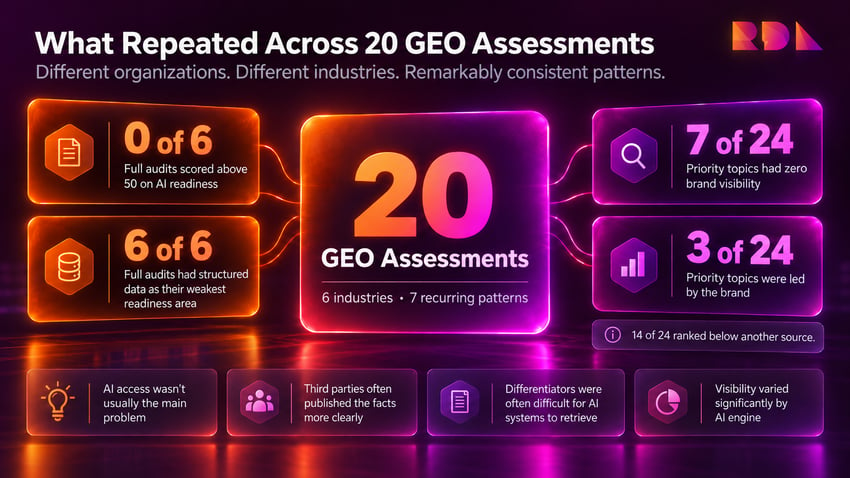
In most cases, AI systems could reach the website. Access was not the primary problem. The bigger issue was what those systems found once they arrived: important facts were difficult to extract, differentiators were buried or implied, key information lacked enough context, and third-party sites often presented the same facts more clearly than the organizations themselves.
Across the 20 assessments, seven patterns kept recurring. Together, they point to a practical lesson for marketing and digital leaders: improving AI visibility is less about chasing a new algorithm than making the information that matters easy to access, understand, verify and attribute, then measuring whether that changes which sources AI engines cite.
Six of the assessments were full readiness and visibility audits with scored roadmaps; fourteen were focused baseline scans of a priority topic. No client is named and no example is presented in a way that identifies one.
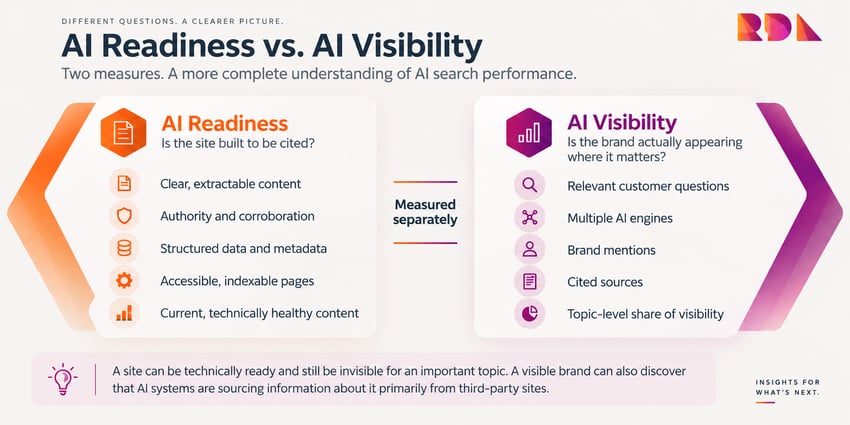
We measured two different things because they answer different questions.
1. AI readiness asks whether a website gives AI systems the information and signals they need to understand and cite it. We assessed five areas: the depth and citability of the content, the organization's authority beyond its own website, structured data and metadata, whether AI systems could access and index the content, and the freshness and technical health of the site.
2. AI visibility measures what actually happens in AI answers. For each priority topic, we tested the questions prospective customers, patients, students or buyers are likely to ask across major AI engines, then recorded which brands appeared and which sources those engines cited.
We keep the two measures separate for an important reason: a technically strong website can still be invisible for an important topic, while a visible brand may discover that AI engines are sourcing information about it primarily from third-party sites.
None of the six organizations we assessed in depth scored above 50 on our AI-readiness rubric; the scores were 28, 32, 33, 36, 48 and 50 out of 100. Several organizations run mature SEO programs and rank well in traditional search. Traditional SEO can help a page rank, but AI citation depends on a broader mix of factors, including whether specific facts can be extracted, understood, attributed and corroborated.
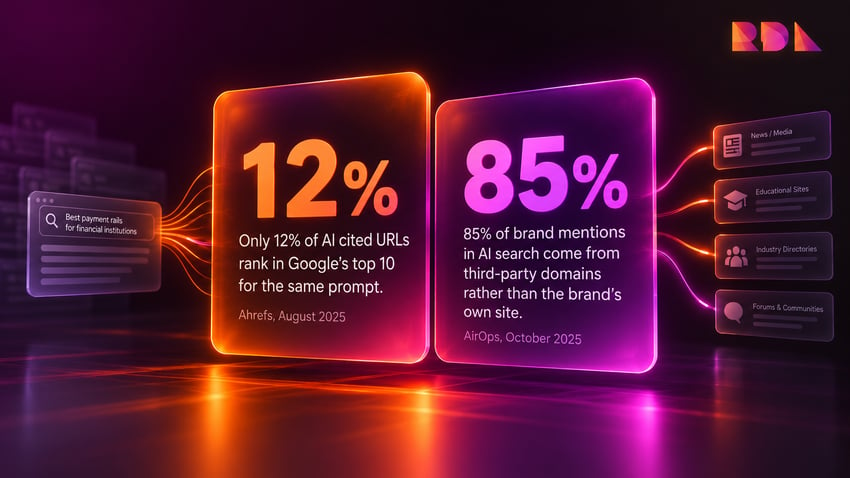
Strong Google performance does not guarantee strong AI visibility. In an August 2025 Ahrefs study of 15,000 prompts, only about 12 percent of the URLs cited by ChatGPT, Gemini and Copilot ranked in Google's top ten for the same prompt. An October 2025 AirOps analysis of more than 21,000 brand mentions across ChatGPT, Claude and Perplexity found that 85 percent came from third-party domains rather than the brand's own site. Our assessments are consistent with both.
Across all six full audits, structured data was the weakest readiness area, with scores of 12, 15, 18, 20, 40 and 40. In practical terms, many sites left AI systems to infer what a page represented and what its most important facts meant.
Structured data is code that explicitly labels that information. It can tell a machine that a page represents a physician, a university course, a product or an organization, then identify facts such as availability, credentials, price or location. Two of the sites we audited had no structured data at all, while two others relied almost entirely on basic markup generated automatically by their CMS.
The specific gaps were consistent. Pages that answered common buyer, patient or prospective-student questions rarely labeled that content explicitly, and provider, product, course and organization pages often lacked markup identifying what the page represented and which facts mattered most. For technical teams, the missing types included FAQPage, Physician, Product and Offer, Course, and Organization with sameAs. It was also one of the more straightforward gaps to address, because much of the work can be implemented at the template level rather than page by page. In every roadmap it sat in the first phase.
One caveat: engines mostly read visible text, so structured data alone will not earn a citation. Its role is to confirm and disambiguate facts the engines are already extracting, so it can reinforce good content rather than substitute for it.
Crawlability was the strongest readiness area in five of six full audits, scoring 52 to 62. None of the six blocked the major AI crawlers in robots.txt, and in every case the engines were already indexing the pages they chose to cite. In one audit a non-browser fetch returned more than 250 kilobytes of server-rendered product HTML, showing that the page content was accessible without a browser.
Yet the site with the highest crawlability score was cited zero times across 240 responses, and none of the more than 1,200 sources those engines cited pointed to its domain. The site was highly accessible, but that accessibility did not translate into citations. The lesson: first confirm that AI systems can access the site. If they can, do not treat crawlability as the strategy; focus on the content, facts and authority those systems encounter.
Two access issues did recur: canonical tags missing site-wide on two of six sites, and answer-critical content such as wait times and product grids loaded by JavaScript on two. A crawler that does not execute scripts sees an empty container where the answer should be.
Across 24 priority topics in the six full audits, the brand ranked first in three, ranked below the leader in fourteen and was completely absent, with zero share of voice and zero cited URLs, in seven. The three first-place finishes shared a trait: each was a category the organization effectively defines. A niche graduate program with few national competitors. A payments organization's own network. A distributor's own parts catalog. In those categories, the organization itself was the primary source and held 34 to 58 percent share of voice.
In adjacent topics, the picture often inverted. The payments organization ranked 51st in an adjacent category where a large fintech held 83 percent share of voice. The university was unranked for its business school, because the page title used an abbreviation while every prompt used the full degree name. The distributor saw no engine quote one of its prices across 350 measured responses, because pricing sat behind a login while competitor prices were quoted freely.
For leadership, the practical move is to stop treating AI visibility as one brand-wide score and prioritize the topics that matter most. Topics where the organization already leads need to stay current and well supported. Important topics where it is absent may require stronger foundational content. The strategy should be different for each.
In the healthcare assessments, booking marketplaces and ratings directories appeared in up to 70 percent of AI answers for provider-selection questions, three health insurers ranked third, fourth and fifth, and no care provider ranked in the top twenty. Half of those prompts turn on whether a doctor accepts a given insurance plan or new patients. Insurers publish that as crawlable text; providers put it in a lookup widget. When one source publishes the answer as clear, crawlable text and another hides it inside a tool or gated experience, the machine readable source has a significant citation advantage.
The same mechanism appeared across industries. A manufacturer published key specifications in a PDF, while distributor roundups exposed the same information as accessible page content and earned the citations instead. A trade association with deep primary research was out-cited on its own subject by consumer finance publishers. A university with strong authority saw rankings sites and forums take the citations while its own domain received none in the non-branded set we analyzed; in one program area it appeared in two of more than 300 topic opportunities.
The solution has two parts. Publish the facts third parties currently publish for you, such as insurance accepted, pricing, lead times, accreditation and outcomes. Then correct and enrich your presence on third-party sources that already appear frequently in AI answers, because in the short term they are a citation channel whether or not you manage them. In several assessments, information about the brand was already reaching AI answers through those platforms, but the citation credit was going elsewhere.
This was one of the most consistent and most avoidable patterns. A medical group's stated differentiator was same-day access seven days a week; a direct fetch of its service pages found no plain-text claim of either. A manufacturer's strongest proof point, a production milestone in the billions of units, lived in a press release no product page linked to. A university program's recognitions appeared nowhere as a dedicated, linkable page.
If a differentiator appears only in an image, video, downloadable document or implied marketing message, an AI system may never encounter it as a clear fact it can retrieve and cite. The first fix is editorial: state the differentiator as a clear factual claim near the top of the page, support it with evidence where available, and reinforce it in content that directly answers the questions buyers actually ask.
Within a single topic, presence varied sharply by engine. One university program ranked first overall yet recorded zero mentions on two of the eight engines tested. One manufacturer performed well on ChatGPT and Gemini yet scored zero of ten on Copilot, which draws on a different search index.
Engine breadth is therefore a distinct measure from prompt coverage, and both belong on the scorecard. Just as important, the baseline should be re-run on the identical prompt and engine basis after changes ship. AI answers are non-deterministic and cited sources can change month to month, so a single snapshot is not enough to measure improvement. A repeated, fixed-basis measurement provides a defensible way to compare movement over time.
Rankings sites held the citations for thin, generic program pages. Several institutional domains competed to answer the same question, making it harder for one authoritative source to emerge.
Marketplaces, directories and insurers won provider-selection prompts because they published access and insurance data as text. Providers with individual surgeon pages were more visible for procedure prompts.
Specifications in PDFs and gated pricing gave distributors and directory roundups an advantage on buying prompts; one incumbent held 36 percent share of voice in a category where the manufacturer held 14.
Dining answers were sourced from business profiles, reviews and reservation platforms rather than brand domains. Visibility depended on complete, consistent listings at every property and on who controls the listing when properties are franchised.
Strong where the organization is the source of record, absent in adjacent categories defined by fintechs and consumer finance publishers, with primary research locked in PDFs.
The first-phase items below appeared in nearly every roadmap. Each is framed as a question a leader can ask, followed by the check a team can run in an afternoon.
A GEO assessment measures whether AI engines such as ChatGPT, Gemini, Perplexity and Copilot cite a brand for the questions users ask in its category, and whether the site gives those engines the information they need to cite it. A full audit scores both and produces a roadmap; a baseline scan measures visibility for a single priority topic.
Readiness assesses the site itself. Visibility measures actual AI answers. A site can be ready and still invisible in a category it has never published for, so the two are scored separately.
Not automatically. Organizations with mature SEO programs still scored between 28 and 50 of 100 on AI readiness, and Ahrefs found that only about 12 percent of URLs cited by AI assistants ranked in Google's top ten for the same prompt.
In our full assessments, structured data was the weakest readiness area every time and one of the more straightforward gaps to address because much of it can be implemented at the template level. It works best alongside clear page content and accurate third-party information, and its effect on visibility should be measured rather than assumed.
They publish the facts users ask about as crawlable text, while brands often keep the same facts in PDFs, widgets, login walls or JavaScript. A source that publishes the answer clearly has a significant citation advantage.
Across 20 organizations, the same patterns kept appearing. The websites were generally accessible, but many of the facts and differentiators that mattered most were difficult for AI systems to extract, interpret or attribute to the brand. Third parties often filled that gap by publishing the same information more explicitly.
That makes AI visibility more than a technical SEO problem. It is also a publishing, content structure and measurement problem. Many of the gaps we found do not require a replatform or a wholesale content rewrite. They require organizations to be deliberate about the questions they want to answer, the facts that support those answers, how those facts are published, and whether those changes improve citation visibility over time.